
Lest we forget…
I don’t really ‘do’ social media. Way back when Facebook came out, I promptly determined that it was only for people who were happy to live their lives in a goldfish bowl, and I’m not one of those. But I did realise that it offered a convenient way for people with interests in common to coordinate their activities, and since I was in a choir that occasionally sprouted little ad hoc ensembles for special occasions, I got myself a ‘page’. Since then, other than responding to the odd call for basses to sing at this, that or the other fundraiser – or funeral – I’ve done nothing with it.
But the other day, it popped its head up with an invitation to a gig. It was a Ukrainian band called Jaga Band, run by Mar’yana Sywak, who many years ago used to be the operations manager for my choir, and the gig was a benefit for the Ukrainian war effort. As a passionate believer in the need for Ukraine not merely to avoid losing its war against Russia, but to win it convincingly, I bought two tickets without even checking that we were free that night. If we couldn’t go – what the hell, it was money going to a good cause.
Happily, it turned out we could go, and so it came about that we turned up at the venue, a few minutes before the doors opened, keen to get a good seat. As we waited, the crowd grew, and it was noticeable that it consisted mostly of women. Maybe they were just keener to get a good seat – there were no reservations for groups of fewer than eight.
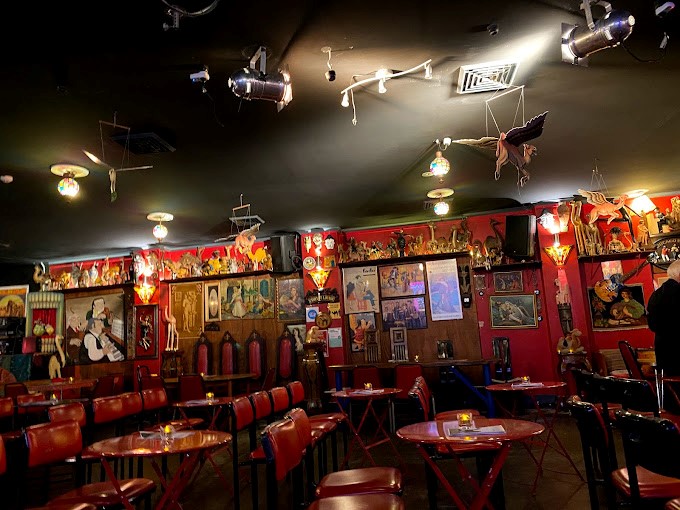
The doors opened, and we climbed the three steep flights of stairs to the Camelot Lounge, a repurposed industrial space in inner-Sydney Marrickville. We found a good table and, along with the other early arrivals, settled down with a drink from the bar. Googling the Jaga Band, we learned that it had originally been an all-female lineup, so perhaps that was why, as the room filled up, we were still seeing many more women than men.
Out came Mar’yana, whom I remembered, probably wrongly, as rather a shy Ukrainian girl. Here, a dozen years later, she crackled with stage presence, telling us that Jaga was the name Ukrainians give to their home-made vodka, and introducing the band, which had acquired a couple of male members, and which included a cimbalom, an instrument that looked, from where we were sitting, like a cross between a zither and a foosball table.
Mar’yana explained that the proceeds of the gig would go to deserving Ukrainian wartime charities, but she didn’t lay it on thick, either then or in the occasional references she made throughout the night to the plight of her homeland. And then we were off, the band reeling off Ukrainian folk classics with unrestrained energy. The Belarusan cimbalom player, who looked like a high-school teacher, or perhaps somebody’s very efficient secretary, seemed at times to go right off her box. Mar’yana herself played a tiny electric violin and a huge, lute-like instrument called a kobza. And she sang, with a big, plangent voice ringing with righteous conviction. Here’s a very rough clip of what we saw and heard.
In any other context, this would have been a very good night of toe-tapping entertainment, and nothing more. But it was starting to dawn on us why the women in the audience so greatly outnumbered the men. Many of these women, in their 30s and 40s, had, I suspect, fled Ukraine in early 2022, leaving behind them men who, if they had survived thus far, were serving in the forces opposed to Russia. As we sat there, and as those of us who could, danced, the sun was high in Ukraine, and these absent men were fighting, bleeding and quite possibly dying.
The crucial importance of a Ukrainian win in deterring would-be aggressors everywhere, but notably China has not been sufficient motivation to retain Western popular attention. With its severe case of ADHD, its eye has drifted away from the war in Ukraine, and towards the events unfolding in the wretched Middle East. Ukraine’s spectacular survival, which entranced so many in the early days of the invasion, has been replaced by a complex, slow-moving attritional battle that provides far less click-bait.
America has done what it so often does early in a conflict for which it has not formulated a theory of victory, and whose true historical importance it imperfectly understands. It has given generously enough to avoid Ukraine’s defeat, yet has restricted Ukraine’s freedom to use its largesse to attack its invader in his home territory, and thereby defeat him. The prospect of a Trump presidency is widely viewed as certain to bring about a decisive concession to Putin. I cling, perhaps naively, to the observation that what Trump does correlates poorly with what comes out of his mouth. I believe he is a narcissist who can yet be persuaded that the defeat of Putin offers him a better prospect of personal glory than pandering to him.
It was afternoon in Ukraine when we cheered the Jaga Band’s final encore. All around me were smiling faces, flushed with the adrenalin rush that good music brings on. Many of those smiling faces would soon be going home, opening up their phones, checking their social media, hoping for the best, but prepared for the worst.
Slava Ukraine!
 Harrumpf.com